

A freight forwarder acts as the main point of contact for the shipment, organizing transportation, preparing documentation, coordinating with carriers, and ensuring compliance with customs regulations.
While they usually don’t move the cargo themselves, they manage the entire process from pickup to final delivery.
This process applies to all types of shipments, including:
- Air freight
- Ocean freight
- Imports and exports
- Multimodal transportation
High Level View of the Freight Forwarding Process
At a high level, the freight forwarding process follows a series of 6 key steps:
- Pickup and origin handling
- Export customs clearance
- International transportation
- Import customs clearance
- Destination handling
- Final delivery
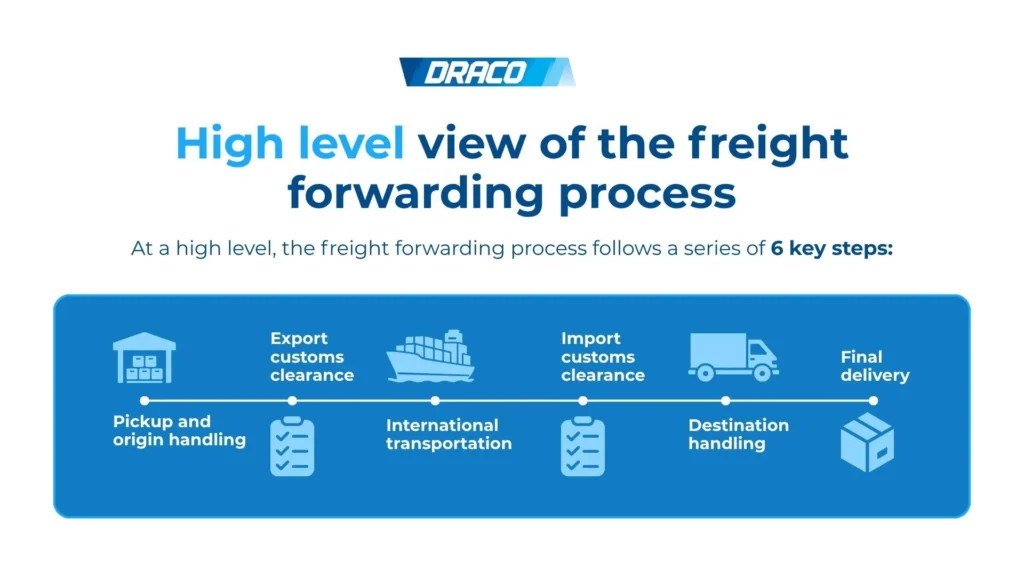
This is the simplified version of the process you’ll see in most guides.
However, in real operations, the freight forwarding process goes far beyond these six steps. Each shipment involves multiple phases, decisions, and coordination between different teams.
In the next section, we break down the full freight forwarding process step by step, based on how we handle shipments daily at Draco.
Full Freight Forwarding Process Step by Step in 2026
The six steps we covered earlier give you a simplified view of how freight moves from origin to destination.
Now, let’s break down how the freight forwarding process works in real operations.
Step 1: Quoting and Booking
Every shipment starts with a request—although in some cases, shipments move under pre-agreed rates without a formal quote, moving directly to Step 2.
The process typically begins when a shipper or consignee provides shipment details such as origin, destination, cargo type, weight, and timing requirements.
From there, the freight forwarder:
- Reviews the shipment requirements
- Sources pricing across different modes (air, ocean, inland)
- Selects the most suitable carriers (airlines, steamship lines, trucking providers)
- Prepares and sends a quote when needed
Forwarders with strong carrier relationships, like we have at Draco, often secure more competitive and stable pricing. These partnerships can provide access to better space availability and exclusive rates that are not always available on the open market.
Once the quote is approved, the shipment is booked with the selected carrier, securing space for the cargo.
This phase defines the routing, cost, and timeline of the shipment, making it one of the most important steps in the entire process.
Step 2: Shipment Preparation and Documentation
Once the shipment is booked, the next step is preparing the cargo and ensuring all documentation is accurate and complete.
At this stage, the freight forwarder collects and verifies all shipment details, including cargo specifications, packaging, and any special handling requirements.
Key activities include:
- Confirming cargo readiness and pickup schedule
- Verifying packaging and labeling requirements
- Preparing shipping documents:
- Commercial invoice
- Packing list
- Bill of lading (ocean) or airway bill (air)
- Checking compliance requirements (hazardous cargo, temperature control, restricted goods)
Accuracy at this stage is critical. Missing or incorrect documentation can lead to delays, customs holds, or additional costs later in the process.
Step 3: Origin Operations
Once the international transportation booking is confirmed, one of the most critical phases of the logistics process begins: origin operations.
At this stage, the cargo starts its physical journey toward the international destination, requiring close coordination among exporters, carriers, freight forwarders, and regulatory authorities.

Origin Operations for Export Shipments
The export process consists of a series of operational, documentary, and customs procedures designed to ensure that goods are transported from the country of origin to the final destination safely, efficiently, and in full compliance with international regulations.
Understanding each stage of the export process is essential for minimizing risks, preventing delays, and optimizing logistics costs.
1. Cargo Collection and Preparation
The export process typically begins with the collection of goods from the exporter’s facilities or their delivery to a designated warehouse.
Prior to shipment, the cargo may undergo several verification procedures, including:
- Physical inspection of the goods;
- Documentation review;
- Packaging and labeling verification;
- Phytosanitary or veterinary inspections, when applicable.
These procedures are critical to ensuring compliance and avoiding issues during international transportation.
2. Value-Added Services in Export Operations
Depending on customer requirements or destination country regulations, additional services may be performed to enhance the security and efficiency of the logistics operation.
Key value-added services include:
- Pallet exchange;
- Palletizing and re-palletizing;
- Stretch wrapping;
- Special labeling;
- Cargo segregation;
- Quantity and volume verification;
- Fumigation;
- Temporary warehousing;
- Cargo consolidation.
These services help ensure that goods meet international requirements and the specific needs of each shipment.
3. Cargo Consolidation: How Does the Process Work?
Cargo consolidation is a common practice for smaller-volume shipments.
Under this model, goods from multiple exporters are combined into a single transport unit, providing several advantages:
- Improved utilization of available space;
- Reduced logistics costs;
- Greater operational efficiency;
- Enhanced optimization of international transportation.
This strategy is widely used in both ocean freight and air freight operations.
4. Export Customs Clearance
Once the cargo has been prepared, the export customs clearance process takes place.
At this stage, the goods are presented to the relevant authorities for authorization to leave the country.
Only after customs clearance has been granted can the shipment proceed to international transport.
5. Issuance of Export Documentation
Following customs clearance, the final shipment documents are issued.
Key export documents include:
- Bill of Lading (or Air Waybill, depending on the mode of transport);
- Cargo Manifest;
- Loading Guide;
- Any additional documents required based on the transportation mode used.
The accurate issuance of these documents is essential to ensure the continuity and success of the international logistics operation.
6. Pre-Alert Submission and Shipment Monitoring
After the shipment has been dispatched, the freight forwarder sends a Pre-Alert to the destination agent, importer, and other relevant stakeholders.
This communication typically includes:
- Cargo details;
- Transportation documents;
- Operational information;
- Estimated arrival date and time.
Providing this information in advance enables all parties involved to prepare for the next stages of the operation, resulting in a more streamlined and efficient process.
A thorough understanding of every stage of the export process enables exporting companies to mitigate operational risks, improve shipment predictability, and achieve greater efficiency in their international trade operations.
Origin Operations for Import Shipments (Pre-arrival)
In import operations, many activities begin even before the physical arrival of the cargo in the destination country. Shipping documents are submitted in advance for review by the relevant authorities and stakeholders, allowing portions of the customs process to be completed prior to the shipment’s arrival.
To facilitate this process, the following documents are typically required:
- Commercial Invoice
- Packing List
- Bill of Lading (BL) or Air Waybill (AWB)
- Certificate of Origin
- Import License / LPCO (when required)
Where permitted by local regulations, pre-clearance procedures can significantly expedite customs clearance, reducing cargo dwell time at ports, airports, or bonded facilities. In addition, documents such as the Arrival Notice and Delivery Order may be prepared in advance to streamline cargo release and final delivery once customs clearance has been completed.
Phase 4: International Transportation
International transportation is responsible for moving cargo between countries. The choice of transportation mode directly impacts costs, transit times, and operational risks. Draco evaluates each shipment and provides the most suitable transportation solutions.
Air Freight
International air freight is the ideal solution for urgent shipments, high-value goods, perishable products, and cargo that requires fast delivery. Its primary advantage is the short transit time, although it generally involves higher costs compared to other transportation modes.
Air Freight Transit Time
Transit times vary depending on the route, flight availability, and customs procedures. For shipments originating in the United States, average transit times are:
- Latin America: 1 to 5 days;
- Europe: 2 to 7 days;
- Asia: 3 to 10 days;
- Africa: 4 to 12 days.
It is important to note that the total lead time also includes pickup, flight connections, customs clearance, and final delivery.
How Much Does Air Freight Cost?
Costs vary based on weight, volume, route, seasonality, and shipment urgency.
As a general reference:
- USD 2 to USD 8 per kg: standard routes and high-volume markets;
- USD 10 to USD 20 per kg or more: peak-demand periods and special cargo.
Main Air Freight Services
Different solutions are available to meet the specific requirements of each operation:
- Express: ideal for documents and small urgent parcels;
- Consolidated (Consol): shared cargo space among multiple shipments, reducing transportation costs;
- Freighter Service: dedicated cargo aircraft designed for large-volume shipments;
- Charter: exclusive aircraft charter for special projects or emergency operations;
- Project Cargo: transportation of machinery, equipment, and critical cargo requiring detailed operational planning.
Special Cargo in Air Transportation
Certain types of cargo require specific handling and documentation procedures, including:
- Dangerous Goods;
- Perishables;
- Live Animals;
- Valuable Cargo;
- Outsized Cargo.
A practical example of logistics efficiency is DRAGON EXPRESS, Draco’ air freight solution connecting China, Miami, and Latin America.
By using Miami as a strategic logistics hub, it enables frequent departures, fast handling, and broad regional connectivity.
With 3–5 day transit times and more than 300 tons moved monthly, it offers a reliable and cost-effective option for time-sensitive imports from Asia.
Ocean Freight
Ocean freight is the most widely used mode of transportation in international trade, accounting for the movement of the majority of goods worldwide. Its primary advantage is the ability to transport large volumes at more competitive costs when compared to air freight.
Cargo can be shipped in a Full Container Load (FCL) or a Less than Container Load (LCL), depending on the shipment volume. Although transit times are generally longer, ocean freight is the ideal solution for planned operations and goods that do not require urgent delivery.
Ocean Freight Transit Time and Costs
Transit times vary according to the route. For shipments originating in the United States, average transit times are:
- Latin America: 7 to 20 days;
- Europe: 10 to 25 days;
- Asia: 25 to 45 days;
- Africa: 20 to 40 days.
Freight rates also fluctuate based on supply and demand, seasonality, port congestion, and equipment availability.
As a general reference:
- 20-foot container (20′ DC): USD 1,000 to USD 5,000;
- 40-foot container (40′ DC or HC): USD 1,500 to USD 8,000;
- LCL shipments: USD 30 to USD 200 per cubic meter (CBM).
Main Ocean Freight Services
In addition to conventional container shipping, several specialized solutions are available to meet different operational requirements:
- Break Bulk: cargo that cannot be accommodated within standard containers;
- Ro-Ro (Roll-on/Roll-off): vehicles, machinery, and wheeled equipment;
- Project Cargo: oversized cargo and industrial projects;
- Charter Vessel: partial or full chartering of a vessel for specialized operations.
Key Operational Requirements
An efficient ocean freight operation requires proper planning and regulatory compliance, including:
- Proper documentation;
- Accurate cargo classification;
- Compliance with customs requirements;
- Adherence to international regulations, such as the IMDG Code for dangerous goods;
- Proper container packing and stowage.
Due to its capacity, versatility, and outstanding cost-effectiveness, ocean freight remains the preferred transportation solution for companies seeking efficiency and competitiveness in international trade.
Multimodal Transport
In many international operations, a single mode of transport is not sufficient to cover the entire logistics journey. In such cases, multimodal transportation is used, combining different modes such as trucking, ocean freight, and air freight.
This integration provides greater operational flexibility, cost optimization, and access to regions without direct connections to major ports or airports.
Phase 5: Destination Customs and Handling
Upon arrival in the destination country, the cargo enters a new phase of review and processing before being released to the importer.

Import Clearance
Import customs clearance involves the submission of the customs declaration, document review, payment of applicable duties and taxes, and any inspections required by regulatory authorities. To successfully complete this stage, it is essential that all required documentation is accurate, complete, and readily available, as outlined in the section “Key Documents in the Freight Forwarding Process.”
Depending on the nature of the imported goods, additional approvals may be required to comply with sanitary, environmental, technical, or safety regulations. These requirements may involve government agencies and regulatory authorities responsible for overseeing product compliance, public health, agriculture, environmental protection, and customs enforcement.
Effective management of the customs clearance process is critical to minimizing delays, avoiding unnecessary storage charges, preventing penalties, and reducing unexpected costs throughout the international logistics operation. Proper planning, documentation accuracy, and proactive coordination with all parties involved contribute significantly to a smooth and efficient cargo release process.
Destination Handling
After customs authorities grant clearance, the cargo proceeds to destination operations.
These activities may include deconsolidation of shared shipments, warehouse transfers, physical inspections, order sorting, and preparation for final distribution.
Phase 6: Final Delivery (Last Mile)
The last mile represents the final stage of the logistics process and has a direct impact on customer experience.
After customs release, the goods are transported by truck to their final destination, whether a distribution center, manufacturing facility, retailer, or end customer.
During this phase, delivery appointments, receiving schedules, and Proof of Delivery (POD) issuance are commonly managed to formally confirm completion of the shipment.
Efficient last-mile management contributes to greater predictability, lower costs, and improved customer satisfaction.
Phase 7: Billing and File Closure
Even after cargo delivery, the freight forwarding process is not yet fully complete.
This stage includes customer invoicing, financial reconciliations, and payments to carriers, logistics operators, and other service providers involved in the supply chain.
Operational and document audits may also be conducted to ensure all contracted services were properly executed and costs remain aligned with the original plan.
Differences Between Air, Ocean, Import, and Export
Air vs Ocean Freight Process
Choosing between air and ocean transportation depends on several factors, including urgency, budget, cargo characteristics, and supply chain planning.
Air freight offers superior speed, shorter transit times, and greater predictability. Ocean freight, on the other hand, provides more competitive costs and higher capacity for large-volume shipments.
In addition to differences in cost and transit time, each mode presents unique operational requirements related to documentation, storage, consolidation, and cargo handling.
Companies that understand these differences are better positioned to select the most appropriate transportation mode for each logistics requirement.
Import vs Export Process
Although both are part of the same international supply chain, imports and exports involve distinct responsibilities.
In exports, the focus is on preparing goods for departure from the country of origin, including documentation, tariff classification, and compliance with the destination country’s requirements.
In imports, the focus shifts to the legal entry of goods, payment of duties and taxes, licensing requirements, and compliance with local regulations.
These documentary, tax, and operational differences make specialized support, such as that provided by Draco, essential throughout every stage of the process.
Who Is Involved in the Freight Forwarding Process
Freight forwarding involves multiple stakeholders working together to ensure the efficient flow of goods.
- Shipper: Responsible for selling and shipping the goods.
- Consignee: The company or individual receiving the cargo at destination.
- Freight Forwarder: Coordinates the entire international logistics operation, connecting carriers, agents, and regulatory authorities.
- Carrier: An airline, ocean carrier, or ground transportation provider responsible for physically moving the cargo.
- Customs Broker: A specialist responsible for managing import and export customs procedures.
In addition to these key participants, international freight operations also involve overseas agents, port and airport terminal operators, third-party logistics providers (3PLs), bonded warehouses, insurance companies, government regulatory agencies, and customs authorities.
Another critical element of the freight forwarding process is the selection and application of Incoterms rules, which define the allocation of responsibilities, costs, and risks between buyers and sellers throughout the transaction.
Depending on the negotiated Incoterm—such as EXW, FOB, CFR, CIF, DAP, or DDP—different parties assume responsibility for transportation, cargo insurance, customs clearance, duties and taxes, and final delivery. As a result, an efficient freight forwarding operation requires not only seamless coordination among all stakeholders but also a thorough understanding of Incoterms to ensure operational predictability, regulatory compliance, cost control, and risk mitigation throughout the logistics process.
Key Documents in the Freight Forwarding Process
Accurate and complete documentation is one of the pillars of international logistics operations.
Commonly used documents include:
- Commercial Invoice
- Packing List
- Bill of Lading (B/L)
- Air Waybill (AWB)
- Certificate of Origin
- Insurance Policy or Insurance Certificate
- Purchase Order (PO)
- Booking Confirmation
- Shipping Instructions (SI)
- Cargo Manifest
- Import Declaration (DI / DUIMP)
- Single Export Declaration (DU-E)
- Import License (LI / LPCO – Licenses, Permits, Certificates, and Other Regulatory Documents)
- Phytosanitary Certificate
- Fumigation Certificate
- Inspection Certificate
- Quality Certificate
- Letter of Credit (L/C)
- Material Safety Data Sheet (MSDS) / Safety Data Sheet (SDS) for IMO and hazardous cargo
- Dangerous Goods Declaration (DGD)
- Electronic Transportation Knowledge Document (CT-e)
- Certificate of Analysis (COA)
Document errors, omissions, and inconsistencies are among the leading causes of delays, customs issues, cargo holds, and unexpected costs in international trade. Ensuring that all documentation is accurate, complete, and compliant with the requirements of the countries and authorities involved is essential for maintaining supply chain efficiency and minimizing operational risks.
Common Issues in the Freight Forwarding Process
Even in well-planned logistics operations, unforeseen events can occur. Cargo damage, loss, and delays may result from adverse weather conditions, operational disruptions, or interruptions across the global supply chain. Proactive risk management is essential to maintaining operational efficiency, minimizing disruptions, and protecting business continuity.
The Top 10 Most Common Freight Forwarding Mistakes
1. Incorrect or Incomplete Documentation
Discrepancies in the Commercial Invoice, Packing List, Bill of Lading (B/L), or Air Waybill (AWB) can lead to customs delays, cargo holds, penalties, and additional costs.
2. Incorrect Commodity Classification
Errors in Harmonized System (HS) codes or tariff classifications may result in customs inspections, shipment delays, fines, and unexpected duty assessments.
3. Insufficient Capacity Planning
Booking shipments at the last minute increases the risk of limited space availability on vessels and aircraft, especially during peak shipping periods.
4. Inadequate Route Selection
Choosing inefficient transportation routes can increase freight costs, extend transit times, and reduce overall supply chain performance.
5. Overlooking Peak Season Demand
Seasonal demand surges can create capacity shortages, port congestion, equipment imbalances, and significant transportation delays.
6. Poor Communication Among Stakeholders
Miscommunication between shippers, freight forwarders, carriers, customs brokers, and consignees can negatively impact operational execution and decision-making.
7. Discrepancies Between Physical Cargo and Documentation
Differences in weight, dimensions, quantities, or cargo descriptions may trigger inspections, customs holds, and additional charges.
8. Failure to Obtain Cargo Insurance
Without adequate international cargo insurance coverage, damage, loss, theft, or other incidents can result in substantial financial losses.
9. Lack of Shipment Monitoring and Visibility
Failure to actively track shipments reduces the ability to respond quickly to disruptions and implement corrective actions when issues arise.
10. Ignoring External Risk Factors
Weather events, labor strikes, port congestion, geopolitical tensions, regulatory changes, and global supply chain disruptions can significantly affect transportation performance and delivery schedules.
Benefits of Working With a Freight Forwarder
Managing international logistics operations requires technical expertise, regulatory knowledge, and a broad network of logistics partners.
A freight forwarder serves as the central coordination point, simplifying processes, reducing risks, and increasing operational predictability.
In addition to optimizing costs and transit times, a specialized partner helps ensure compliance with customs requirements, document management, and rapid problem resolution throughout the supply chain.
At Draco, we oversee every stage of the freight forwarding process with a focus on efficiency, transparency, and security, helping companies manage international operations with greater control and confidence. Contact our specialists to learn how we can optimize your global logistics operations.
Frequently Asked Questions (FAQ)
It is the set of activities responsible for planning, coordinating, and executing the international transportation of cargo between origin and destination.
Transit times vary depending on the transportation mode, route, origin and destination countries, and customs procedures involved.
The primary documents include the Commercial Invoice, Packing List, transport document, Certificate of Origin, and any product-specific regulatory documentation.
The freight forwarder coordinates the entire logistics operation, while the carrier is responsible for the physical movement of the cargo.
Freight forwarding involves multiple stakeholders, international regulations, customs requirements, transportation modes, and documentation that must be perfectly aligned.
Even minor mistakes can result in delays, penalties, additional costs, and disruptions to the supply chain. For this reason, structured processes and specialized partners are essential to ensuring secure, efficient, and compliant international operations.
Would you like to reduce risks, optimize costs, and gain greater visibility into your international operations? Contact the Draco Freight Logistics team and discover how specialized freight forwarding management can transform your global logistics strategy.